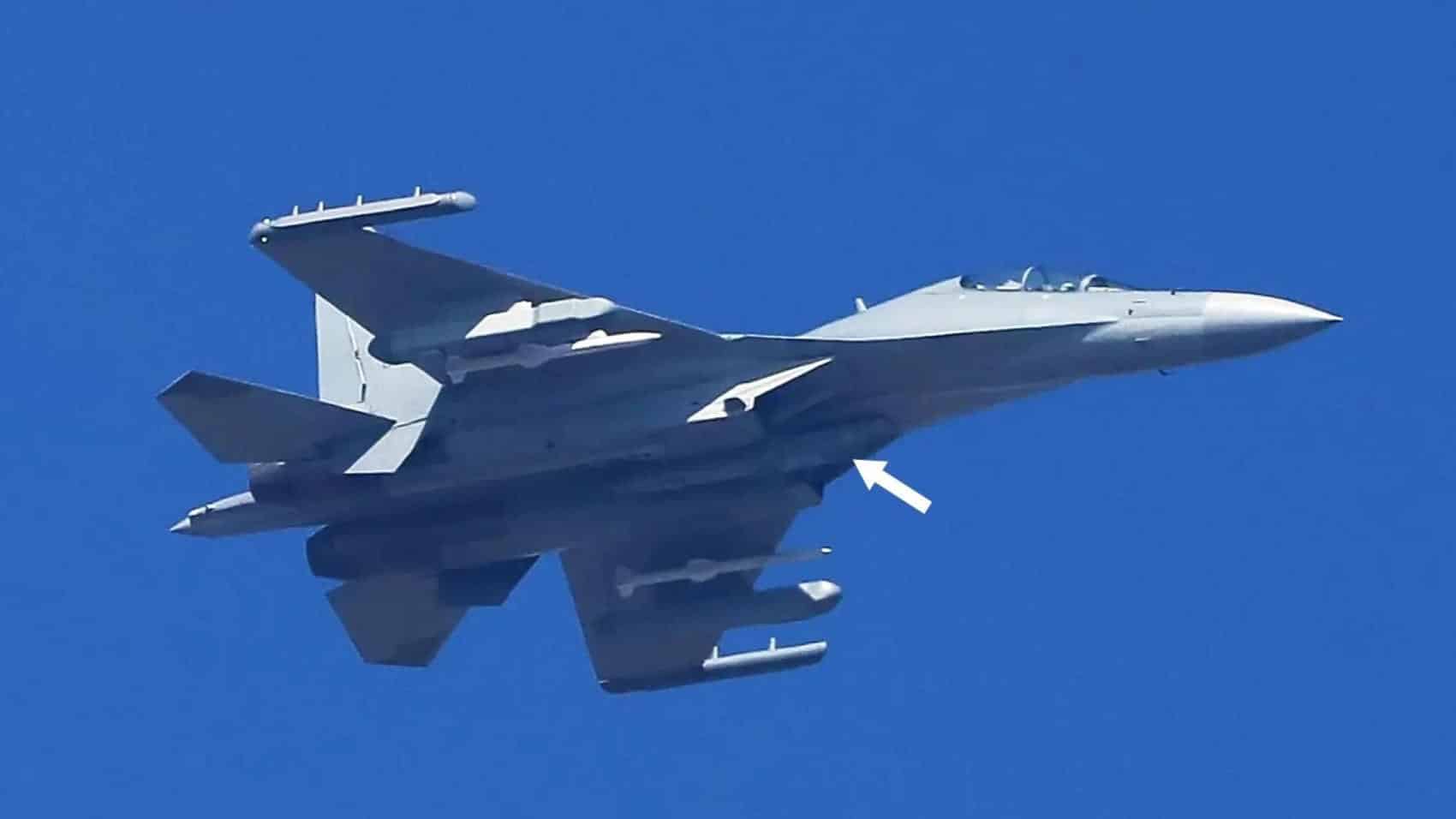
A few days ago, photos surfaced showing a J-16D in flight with three RKZ930 jamming pods and two missiles, the first public appearance of an armed configuration on this variant. The missiles' identities remain uncertain, possibly PL-15 or LD-8A, but the observed configuration leaves little doubt that the PLA Air Force's electronic warfare capabilities have reached a new level. This is similar to the situation with China's carrier-based fighters, as an image of a J-15DT carrying at least three GE electronic warfare pods also recently emerged.
The RKZ930 electronic warfare pod is present on both the J-16D and the J-15DT.
The J-16D was publicly unveiled at the China 2021 Airshow in Zhuhai as a dedicated electronic warfare platform. Its designers described it as " irreplaceable within the air forceThis could lead to a central doctrinal stance. Wang Yongqing, chief expert at the Shenyang Aircraft Design and Research Institute, had emphasized its importance for operations. Shortly afterward, Chinese state television reported the start of combat exercises. The sequence marked the transition from showcase to fieldwork.
Although limited, publicly available information highlighted the integration of reconnaissance, attack, and defense capabilities on a single platform, designed to counter advanced air defenses. The modular architecture of the RKZ930 pods, with a central element between the engines and underwing pods, aimed for adaptation by frequency band and threat. The objective was to simultaneously gather, degrade, and protect, supporting electromagnetic mission coordination.
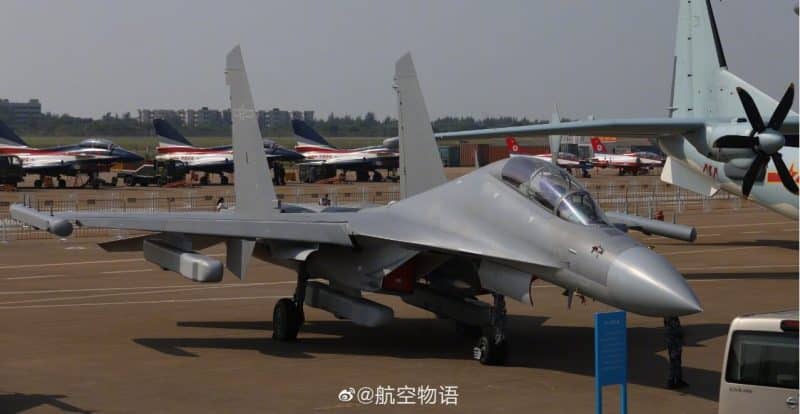
In this context, the airframe had been optimized for penetration and jamming, with the IRST and internal cannon removed compared to the original design. Local reports indicate that the J-16D has since been used in support of J-20 stealth fighter deployments, to open and secure flight paths. This pairing illustrates a division of roles where the group's survivability relies on electromagnetic superiority.
On the naval side, the J-15DT, the carrier-based counterpart to the J-16D and equivalent to the American EA-18G Growler, was designed exclusively for catapult-launched aircraft carriers like the Fujian. Offering a greater payload capacity than the original J-15, the J-15DT extended the aircraft's range and endurance, as well as its payload, including the number of jammers and munitions.
Catapults allow for takeoffs with more fuel and equipment, making sustained escort sorties more feasible. According to available analyses, such missions remained difficult from ski-jump-launched ships like the Liaoning and the Shandong. Therefore, the Fujian's embarked air group will have organic electronic warfare coverage.
The exercises broadcast by Chinese media in 2021 confirmed the transition to practical use and the major role assigned to the J-16D. However, in the absence of subsequent corroborating information, the precise status of the aircraft, as well as that of its carrier-based counterpart, remained uncertain, as did the doctrines of use.
The J-16D observed for the first time with long-range missiles
A recent photograph, featured as the main illustration, sheds some light on these matters. It shows a J-16D carrying three RKZ930 family pods and two large missiles under its wings. This is the first public observation of an armed payload in flight on this variant. This configuration includes two underwing pods and one inline pod between the engines, with wingtip elements. It indicates advanced training, but does not, on its own, establish an operational status.
Access the full analysis
This article is reserved for MetaDefense subscribers. A subscription gives you access to all analyses, reports, and insights published on the site.
No commitment. From €1,99.