

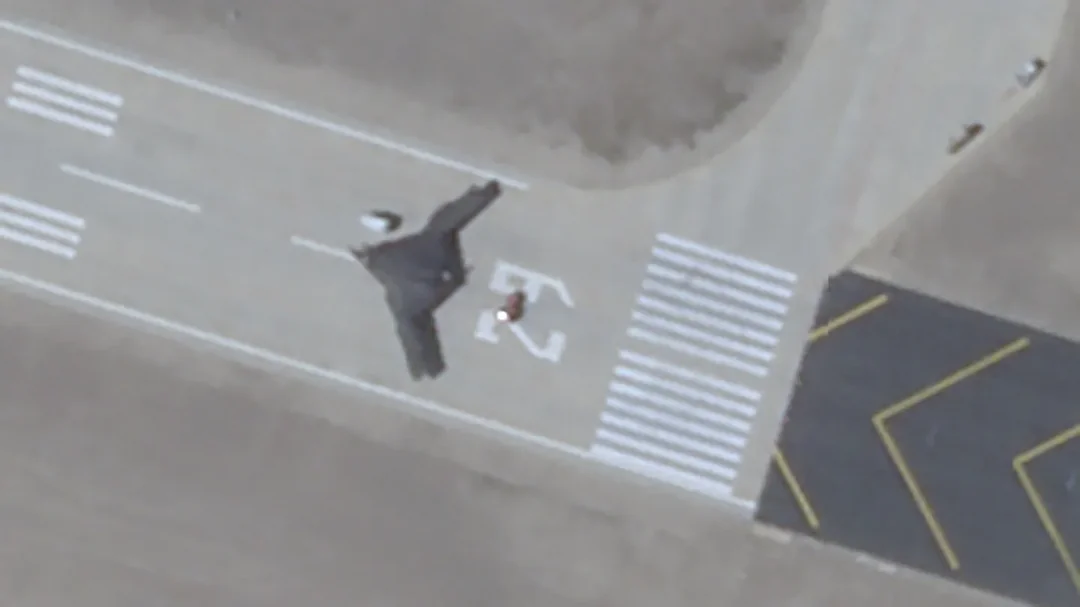
Commercial satellite images dated March 26, 2026, show for the first time two large high-altitude stealth flying wings with long endurance, including the highly anticipated HALE drone WZ-X, simultaneously outside their hangars at the Chinese testing base near Malan, Xinjiang. Identified and analyzed by the specialized site The War Zone from Planet Labs views, they confirm sustained activity at this site known to host the People’s Liberation Army’s unmanned aircraft programs. The overall picture illustrates a particularly dense sequence of ground and tarmac tests on this date.
The larger aircraft, commonly referred to as WZ-X and nicknamed The Monster of Malan, is visible on the main tarmac, at the edge of the runway. Its wingspan is estimated at about 53 meters, comparable in size to a B-2 Spirit stealth bomber. Its official designation and manufacturer are not publicly documented. Another image taken later that day shows this same aircraft moving from a hangar complex to the taxiway.
The second aircraft, stationed in front of a hangar of a recently built complex with enhanced security measures on the other side of the base, adopts a curved delta wing configuration. Its wingspan is estimated at around 42 meters. Observers consider it heavier at maximum weight and likely have a lower operational ceiling. Analysts primarily associate it with intelligence, surveillance, and reconnaissance missions, known as ISR, while also suggesting a potential use as an unmanned combat aerial vehicle, or UCAV, for long-range strikes.
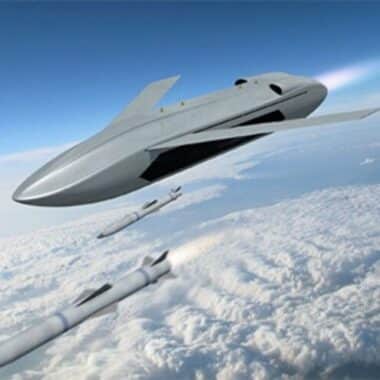
The two flying wings appear to have accumulated flights over the past few months, according to recent indications. Their simultaneous presence in the open on March 26 and the movements observed during the day support the hypothesis of an active flight testing campaign, accompanied by ground checks. However, no official indications have been communicated regarding the progress of the programs or potential evaluations for operational use.
Another image from March 26 also shows a fighter-type drone on the main tarmac, approximately the size of a light to medium manned aircraft, along with a Xi’an Y-20 transport aircraft. This co-occurrence of aircraft with varied profiles attests to a sustained testing tempo at Malan, with parallel activities being conducted. This aligns with an already noted increase in cadence in recent months at this site, which concentrates resources dedicated to new Chinese aerial systems.
Previous imaging milestones shed light on this trajectory. A Planet Labs view dated May 14, 2025, already showed a very large flying wing stationed at Malan, with a wingspan then estimated at about 170 feet, close to the 172 feet of the B-2. Another image released separately showed it in flight, landing gear extended, with a broad flattened center section and marginal fins reminiscent of B-2 style surfaces. However, the low resolution limits detailed identification of the inlets and outlets.
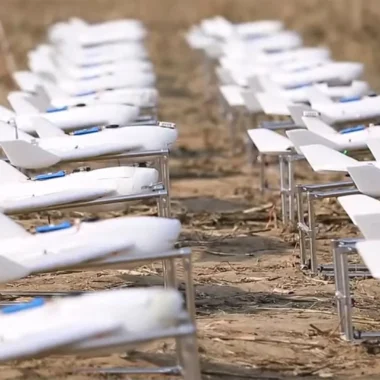
The base near Malan is used for drone testing and advanced exercises. A panoramic view of an exercise conducted at the end of 2025 showed dozens of drones lined up on the eastern part of the tarmac. The arrangement of facilities, with multiple secured enclosures and recent hangars, indicates a capacity to simultaneously conduct several programs and organize large-scale test sequences, including interactions with manned vectors when required.
In terms of configurations, China has presented numerous concepts for fighter-type drones in recent years, similar to U.S. Collaborative Combat efforts. A parade in 2025 highlighted these projects publicly. Since then, testing has significantly increased for at least one tailless configuration, comparable in size to a fighter, whose wing resembles that of a new generation manned fighter project and other supporting aircraft seen in flight.
The dimensions and planform differential between the WZ-X and the second flying wing suggest the development of a family of large flying wing aircraft, designed for distinct roles ranging from ISR to heavy-strike options. The joint appearance of a Y-20 and a fighter-type drone on the same tarmac reinforces the idea of tests being conducted in an integrated environment with various vectors. However, these elements remain indications based on imagery observations, without official confirmation of the assigned missions.
This new glimpse into Chinese programs comes as clearer views of the American stealth drone RQ-180, also classified as HALE, have recently circulated, with the aircraft being presented as operationally employed. In this context of gradual unveilings, caution remains prudent. Spectacular silhouettes and oversized dimensions do not presage the maturity of sensors and data links, nor real survivability against adversary defenses, aspects not reflected in satellite imagery alone.

